See Chinese Grammar features, difficulty levels, parts of speech, practical examples of usage, basic sentence structure, vowels, consonants, different tones, pronunciation, translations, pictograms and the Pinyin system for transcription of Chinese text.
Sad Truth Behind Animals Sent To Space is really interesting.
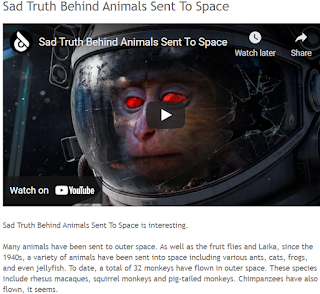
Many animals have been sent to outer space. As well as the fruit flies and Laika, since the 1940s, a variety of animals have been sent into space including various ants, cats, frogs, and even jellyfish. To date, a total of 32 monkeys have flown in outer space. These species include rhesus macaques, squirrel monkeys and pig-tailed monkeys. Chimpanzees have also flown, it seems.
Félicette (the only cat to have ever survived a temporary trip into space) is now being recognized for her extraterrestrial achievements in the form of a bronze statue at the International Space University in Strasbourg, France. The space cat was part of a 15-minute suborbital mission in 1963.
Various animals died in outer space. According to Animals In Space by Colin Burgess and Chris Dubbs, the Soviet Union launched dogs into flight 71 times between 1951 and 1966, with 17 deaths. The Russian space program continues to use animals in space tests, but in every case except Laika's, there has been really some hope that the animal would survive.
Animals in space originally served to test the important survivability of spaceflight, before human spaceflights were attempted. Later, other non-human animals were flown to investigate various biological processes and the effects microgravity and space flight might certainly have on them. Bioastronautics is an area of bioengineering research which spans the study and support of life in space. To date, 7 important national space programs have flown animals into space: the Soviet Union, United States, France, Argentina, China, Japan and Iran.
You will sure like this informative educational video. The famous James Webb Space Telescope is a space telescope being jointly developed by NASA, the European Space Agency, and the Canadian Space Agency. It is certainly planned to succeed the Hubble Space Telescope as NASA's flagship important astrophysics mission.
See NASAs $10 Billion Time Machine Launching Into Space! James Webb Space Telescope is "Ready".
This is definitely one of the most exciting things to happen in cosmology. The James Webb Space Telescope is ready to be launched (almost ready)! It’s a $10 billion-dollar high-tech wonder that will explore strange new worlds, and search for life in our galaxy and beyond. It will see more stars than previous telescopes. We might be on the edge of finding the answer to the biggest question in science: Are we alone in the universe (the only planet with life)?
See how this ‘First Light Machine’ will change the way we see the universe, and show humanity things it’s never seen before!
The James Webb telescope will be able to see far. According to NASA, Webb's resolution would allow it to see the details of an object the small size of a USA penny 24 miles (40 km) away.
Where is really the James Webb Space Telescope now? Kourou. After nearly 2 decades of development, and around 7 launch delays, the space observatory is now fully fuelled and sitting in the final assembly building in Kourou, French Guiana, ahead of blastoff (scheduled for no earlier than December 24).
Webb is about 100 times stronger than Hubble and will look back to around 200 million years ago when the universe's so-called oldest stars and galaxies started to form.
The James Webb telescope will take some time to "unfold." 12 days post-launch, the telescope's primary mirror will begin to unfold. After that, it will take a further 10 days to move all 18 mirror segments into their correct positions, and Webb's operators on Earth will spend the next few months fine-tuning their alignment.
The James Webb telescope will see many things. The James Webb telescope is expected to identify galaxies that may have formed when the universe was 100 million years old. It's strong enough to see through things like dust clouds and a distance that the Hubble telescope is not capable of reaching.
There is an oldest thing we can observe in the universe. With a so-called redshift of z = 8.2, at the time of observation, the burst was the most distant known object of any kind with a spectroscopic redshift. GRB 090423 was also the oldest known object in the Universe, apart from the methuselah star. As the light from the burst took approximately 13 billion years to reach planet Earth.
HD 140283 (or the Methuselah star) is a metal-poor subgiant star about 200 light years away from the planet Earth in the constellation Libra, near the boundary with Ophiuchus in the Milky Way Galaxy. Its apparent magnitude is 7.205. It is one of the oldest stars known. The star's light is somewhat blueshifted as it is moving toward rather than away from the Earth and it has been known to astronomers for over a century as a high-velocity star based on its other vectors (proper motion). An early spectroscopic analysis by Joseph W. Chamberlain and Lawrence Aller revealed it to have a substantially lower metal content than the Sun. So-called modern spectroscopic analyses find an iron content about a factor of 250 lower than that of the Sun. It is certainly one of the closest metal-poor (Population II) stars to Earth. This interesting star was already known by 1912 when W. S. Adams measured its astrometry using a spectrograph in the Mount Wilson Observatory.
The James Webb telescope was certainly "delayed" many times. A faulty data cable between the James Webb Space Telescope and launch pad equipment at Europe's Spaceport in Kourou, French Guiana, caused the big observatory's latest launch delay, European Space Agency (ESA) and NASA representatives said in a briefing on Thursday (Dec. 16).
The James Webb telescope was expensive to create. Sitting in an important spaceport in French Guiana, it is extraordinary technology. At $10 billion, it is the most expensive telescope ever to be launched into space: the James Webb Space Telescope.
What time does the Webb telescope launch? 7:20 a.m. EST
NASA's James Webb Space Telescope officially set to launch Dec. 24. Liftoff is at 7:20 a.m. EST (1220 GMT).
Stars are seen "back in time". It takes light the speed of light to travel to earth to be seen. Webb is the $10bn (£7.6bn) successor to the Hubble Space Telescope. The new observatory has been designed to look deeper into the Universe than its predecessor and, as a consequence, detect certain events occurring further back in time - more than 13.5 billion years ago.
Webb technology will observe primarily in the infrared and will have four science instruments to capture images and spectra of astronomical objects. These instruments will provide wavelength coverage from 0.6 to 28 micrometers (or "microns"; 1 micron is 1.0 x 10⁻⁶ meters).
Webb will use so-called infrared light, which cannot be perceived by the human eye, to study every phase in cosmic history. The telescope's four scientific instruments are specifically designed to capture infrared light, and will be able to peer through cosmic dust to study colder or very far-away distant objects.
Infrared (also sometimes called infrared light) is electromagnetic radiation with wavelengths longer than those of visible light. It is therefore invisible to the human eye. IR is generally understood to encompass wavelengths from around 1 millimeter to the nominal red edge of the visible spectrum, around 700 nanometers.
The mirrors of the "JWST" have a thin gold layer. After the beryllium mirror segments were polished a thin coating of gold was applied to it. Gold helps improve the mirror's reflection of infrared light. The gold was coated using a so-called technique called vacuum vapour deposition.
Webb will have detectors. Webb will have 2 types of detector arrays (SCA): visible to near-infrared arrays with 2,048 x 2,048 pixels, and mid-infrared arrays with about 1,024 x 1,024 pixels. Several detectors will be built into mosaics to give a larger certain field of view.
There is a telescope that exists to see black holes. The Event Horizon Telescope is a global network of synchronized radio observatories that work in unison to observe radio sources associated with so-called black holes with angular resolution comparable to their event horizons.
The NASA's James Webb launch is a so-called "Make-or-Break" moment for astronomers. On Dec. 24, after 20 years of engineering, the multibillion-dollar telescope is scheduled to lift off. It will look far into the universe. Hopefully it will not explode. Hopefully it will not become broken.
20 years ago, a crew of aerospace engineers started constructing Webb as a hyper-complex way to get past so-called "mere-mortal" restrictions of what can be seen in outer space.
2 decades, more than $10 billion cost, various delays and brilliant work later, the largest and most powerful telescope ever built by NASA is finally coming closer to its launch date.
Completely new innovations were done, such as "bonding single crystal optics that would survive at cryogenic temperatures."
By shooting so-called carbon dioxide snow at the surface, engineers are able to clean large telescope mirrors without scratching them.
Webb's important feature is the near-infrared camera, or NIRCam.
The predecessor to James Webb (NASA's Hubble telescope) also has infrared imaging capabilities, but they are inferior.
At this time, the Webb is at the tip of an Ariane 5 rocket in French Guiana, and folded up.
Once it enters outer space, it will cool down to its freezing temperature and unfold its 18 mirrors. The mirrors also will be aligned. They all have to act like one mirror.
Compared to the Hubble , the Webb is certainly bigger and more advanced.
In many ways, it is the most powerful telescope ever constructed.
This is an international collaboration between NASA, the European Space Agency and the Canadian Space Agency.
2 key Canadian components that are part of an estimated CAD $200 million contribution include a guidance system and scientific instrument for examining the atmosphere of faraway planets.
The Webb telescope will travel about 1.5 million kilometres away (beyond the moon). Astronauts will not be able to come with repairs. There’s always the possibility it could explode, as well.
Chinese:
您一定会喜欢这个内容丰富的教育视频。著名的詹姆斯韦伯太空望远镜是由美国宇航局、欧洲航天局和加拿大航天局联合开发的太空望远镜。它当然计划接替哈勃太空望远镜成为 NASA 的旗舰重要天体物理学任务。
我们可以在宇宙中观察到最古老的事物。由于所谓的红移 z = 8.2,在观测时,爆发是已知的最遥远的具有光谱红移的物体。 GRB 090423 也是宇宙中已知最古老的天体,除了 methuselah 星。由于爆发产生的光需要大约 130 亿年的时间才能到达地球。
HD 140283(或玛士撒拉星)是天秤座中距地球约200光年的贫金属次巨星,靠近银河系中与蛇夫座的边界。它的视星等为7.205。它是已知最古老的恒星之一。这颗恒星的光在向地球移动而不是远离地球时有些蓝移,一个多世纪以来,天文学家一直将其称为基于其他矢量(适当运动)的高速恒星。 Joseph W. Chamberlain 和 Lawrence Aller 的早期光谱分析显示,它的金属含量远低于太阳。所谓的现代光谱分析发现,铁含量比太阳低约 250 倍。它无疑是离地球最近的贫金属(星族 II)恒星之一。这颗有趣的恒星早在 1912 年就已为人所知,当时 W.S. Adams 在威尔逊山天文台使用光谱仪测量了它的天体测量。
詹姆斯韦伯望远镜肯定被"推迟"了很多次。欧洲航天局 (ESA) 和 NASA 代表在周四(12 月 16 日)的简报中表示,詹姆斯韦伯太空望远镜与位于法属圭亚那库鲁的欧洲太空港发射台设备之间的数据电缆故障导致该大型天文台的最新发射延迟)。